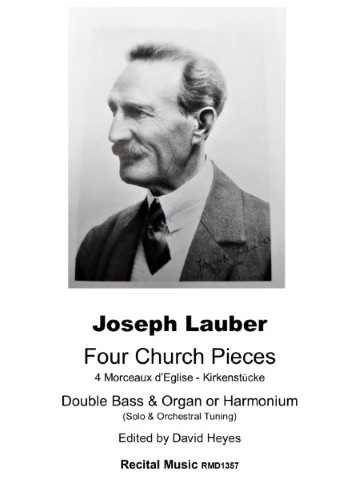
Joseph Lauber (1864-1952) studied in Munich and Paris and pursued a career as an organist, composer and teacher, subsequently becoming professor at Zurich and Geneva conservatoires. He was a prolific composer, writing in many genres, and his music has been described by harpist Alison Young as “rich, romantic and pastoral with a Swiss flavour – something tinged with the utter beauty of the landscape…”
Austrian bassist Hans Fryba (1899-1986) was Principal Bass of the Suisse Romande Orchestra in Geneva from 1929, a post he held for four decades, and his mastery of the double bass inspired the Swiss composer Joseph Lauber to write a number of works for the instrument.
The 4 Church Pieces by Jospeh Lauber date from October 1938 and are scored for solo double bass and organ (or harmonium), also playable with…
The 4 Church Pieces by Jospeh Lauber date from October 1938 and are scored for solo double bass and organ (or harmonium), also playable with piano. Originally in solo tuning, each miniature is beautifully crafted and shaped, employing the solo and lyrical register of the double bass. Fryba inspired Joseph Lauber to explore and exploit the sonorous upper register of the instrument with each piece offering musical and technical challenges in equal measure. Whether played with organ or piano, these colourful and engaging miniatures are a welcome addition to the advanced solo repertoire.
The double bass as a solo instrument dates back to the middle of the 18th-century and the vast majority of its, Repertoire is written by player-composers and also by composers inspired by solo bassists.