Ludwig van Beethoven was a German composer and pianist, a pivotal figure in the transition between the Classical and Romantic eras in classical music. He was baptized on December 17, 1770, in Bonn, Germany, and died on March 26, 1827, in Vienna, Austria.
Beethoven is widely regarded as one of the greatest composers in the history of Western music. His works rank among the most performed pieces in the classical music repertoire. His career is conventionally divided into early, middle, and late periods. The early period, where he honed his craft, is typically considered to have lasted until 1802. His middle period, sometimes characterized as “heroic,” showed individual development from the styles of Joseph Haydn and Wolfgang Amadeus Mozart and lasted until around 18. During this time, Beethoven began to grow increasingly deaf. His late period, from 1812 to his death, extended his innovations in musical form and expression.
Some of his most notable works include the Symphony No. 5 in C Minor, the Symphony No. 9 in D Minor with the famous “Ode to Joy,” the “Moonlight” Sonata, the “Emperor” Concerto, and the “Archduke” Trio. His only opera, Fidelio, was first performed in 1805 and revised to its final version in 1814.
Beethoven’s personal life was marked by struggles, including his gradual hearing loss, which led to total deafness. Despite this, he continued to compose masterpieces, and his music remains a testament to his genius and the enduring power of human creativity.
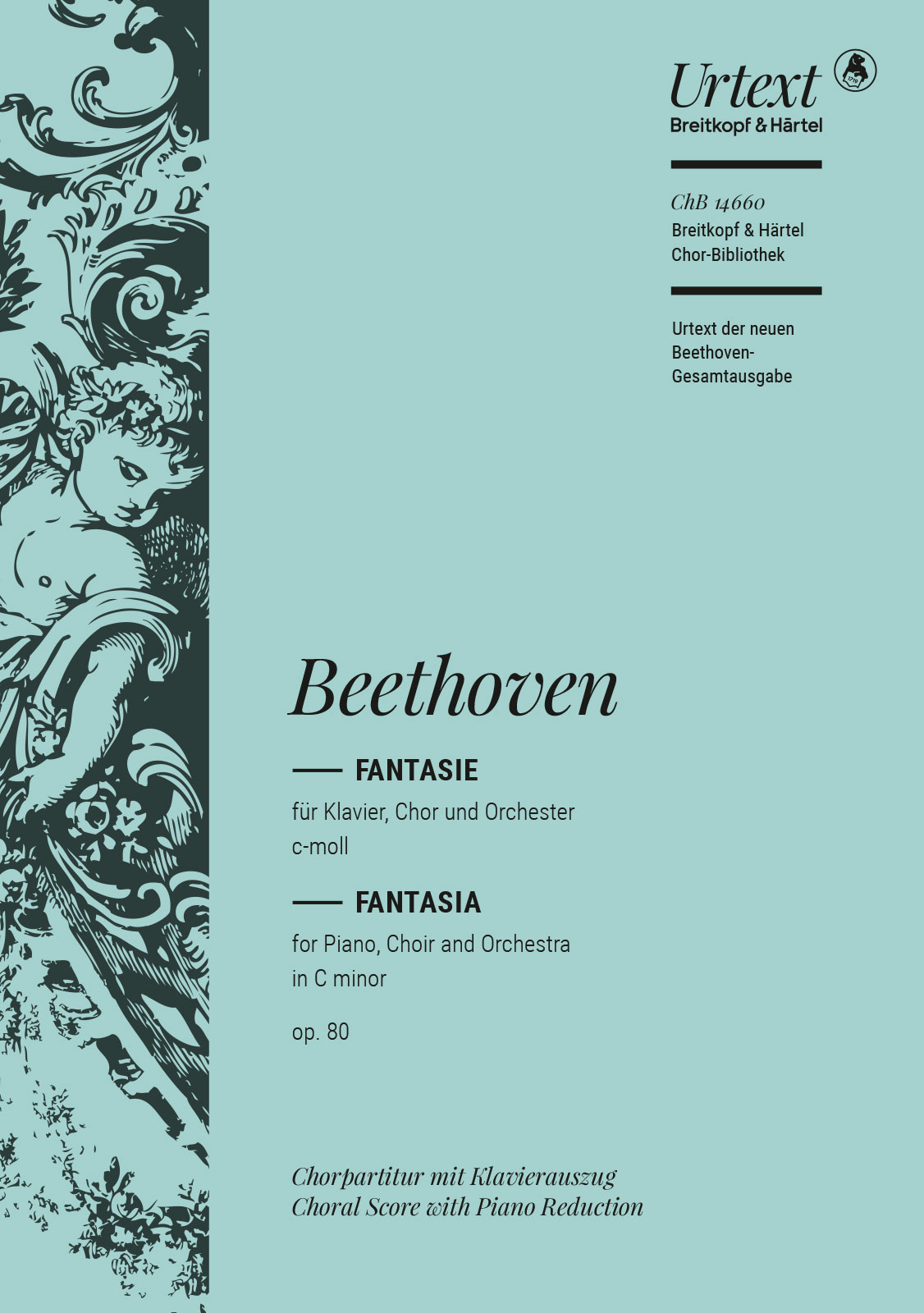
When Beethoven first combined a piano concerto and a cantata to create a new and unique work in his Choral Fantasy op. 80 in 1808,…
When Beethoven first combined a piano concerto and a cantata to create a new and unique work in his Choral Fantasy op. 80 in 1808, the crowning finale was a melody that is reminiscent to the “Ode to Joy” from the finale of his Ninth Symphony. The structure of the Fantasy is also considered a precursor to his Ninth Symphony.
Relatively spontaneously, Beethoven decided to compose a “splendid final piece” for the extraordinary Academy Concert on 22 December 1808 at the Theater an der Wien, alongside his Fourth Piano Concerto, the scene and aria “Ah, perfido!” and parts from the C major Mass, as well as the premiere of the Fifth and Sixth Symphonies, which would unite all those involved.
Beethoven drew on his song “Gegenliebe” (WoO 118), written back in 1794/95, “sketched the variations and the chorus, and the poet Kuffner then had to quickly write the words for it,” as Carl Czerny reported. However, the choral fantasy was not yet completed, so that Beethoven had to improvise the piano part at the beginning of the performance. The complete autograph is lost, only the short score of the choral parts has survived. Beethoven composed the solo piano part only for the editions published by Breitkopf & Härtel in London in 1810 and in Leipzig in 1811.. The Choral Fantasy op. 80 is thus a fascinating testimony to Beethoven’s art of improvisation at the piano.
The edition uses the engraving of the New Beethoven Complete Edition, the corresponding volume was edited by Armin Raab. As an alternative, Breitkopf & Härtel offers an edition by Clive Brown, which has a more compact layout and is particularly oriented towards historical performance practice.
R.R.P 8
Our Price: 7
Digital Download – PDF
Please create and forward a copy of this publication to the customer