Sonata in A, Op.5 no.2 (RV30)
Sonata in B minor, Op.5 no.4 (RV35)
Sonata in Bb, Op.5 no.3 (RV33)
Sonata in F, Op.5 no.1 (RV18)
ABRSM Grade 6 List A: Preludio and Allemanda (1st and 2nd movts from Sonata in B-, Op. 5 No. 3, RV 33)
Trinity College Grade 6 Group A: Allemanda (2nd movt from Sonata in B minor,op. 5 no. 4, RV 35)
Antonio Vivaldi was an Italian Baroque composer, virtuoso violinist, and teacher born on March 4, 1678, in Venice. He is best known for his contributions to the development of the concerto form and for his numerous concertos for violin and other instruments. Vivaldi’s most famous work is “The Four Seasons,” a series of violin concertos that depict scenes appropriate for each season of the year.
Vivaldi’s early life was marked by his musical talent, which was evident from a young age. He began studying for the priesthood at the age of 15 and was ordained at 25. However, due to a health problem, he was given dispensation to no longer say public Masses.
Throughout his career, Vivaldi composed over 500 concertos, more than 40 operas, and numerous sacred choral works. Many of his compositions were written for the all-female music ensemble of the Ospedale della Pietà, a home for abandoned children in Venice.
Vivaldi’s influence during his lifetime was widespread across Europe, giving origin to many imitators and admirers. He pioneered developments in orchestration, violin technique, and programmatic music. Despite his success during his lifetime, Vivaldi died in poverty in Vienna on July 28, 1741.
After almost two centuries of decline, Vivaldi’s musical reputation underwent a revival in the early 20th century. Many of his compositions, once thought lost, have been rediscovered and continue to be performed and celebrated today.
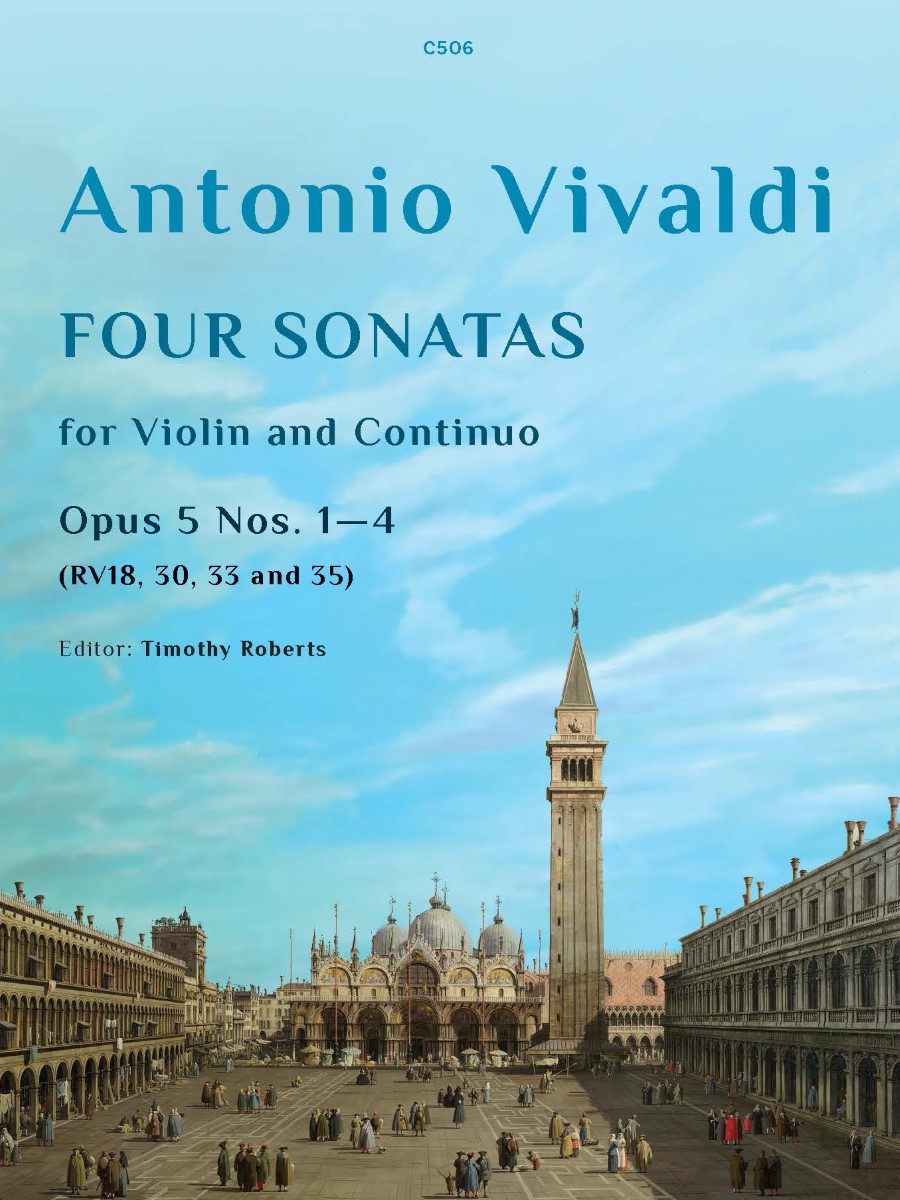
Vivaldi Four Sonatas Opus 5 Nos. 1 – 4: The Opus 5 Sonatas were first published in Amsterdam in 1716. The first four are for…
Vivaldi Four Sonatas Opus 5 Nos. 1 – 4: The Opus 5 Sonatas were first published in Amsterdam in 1716. The first four are for solo violin and continuo and appear in this volume. Numbers 5 and 6 are ‘Trio Sonatas’ for two violins and continuo.
The order we have adopted pays tribute to Professor Michael Talbot’s legendary edition, first published by European Music Archive (EMA101),now sadly unavailable. Editorial suggestions are shown in square brackets.