Ludwig van Beethoven was a German composer and pianist, a pivotal figure in the transition between the Classical and Romantic eras in classical music. He was baptized on December 17, 1770, in Bonn, Germany, and died on March 26, 1827, in Vienna, Austria.
Beethoven is widely regarded as one of the greatest composers in the history of Western music. His works rank among the most performed pieces in the classical music repertoire. His career is conventionally divided into early, middle, and late periods. The early period, where he honed his craft, is typically considered to have lasted until 1802. His middle period, sometimes characterized as “heroic,” showed individual development from the styles of Joseph Haydn and Wolfgang Amadeus Mozart and lasted until around 18. During this time, Beethoven began to grow increasingly deaf. His late period, from 1812 to his death, extended his innovations in musical form and expression.
Some of his most notable works include the Symphony No. 5 in C Minor, the Symphony No. 9 in D Minor with the famous “Ode to Joy,” the “Moonlight” Sonata, the “Emperor” Concerto, and the “Archduke” Trio. His only opera, Fidelio, was first performed in 1805 and revised to its final version in 1814.
Beethoven’s personal life was marked by struggles, including his gradual hearing loss, which led to total deafness. Despite this, he continued to compose masterpieces, and his music remains a testament to his genius and the enduring power of human creativity.
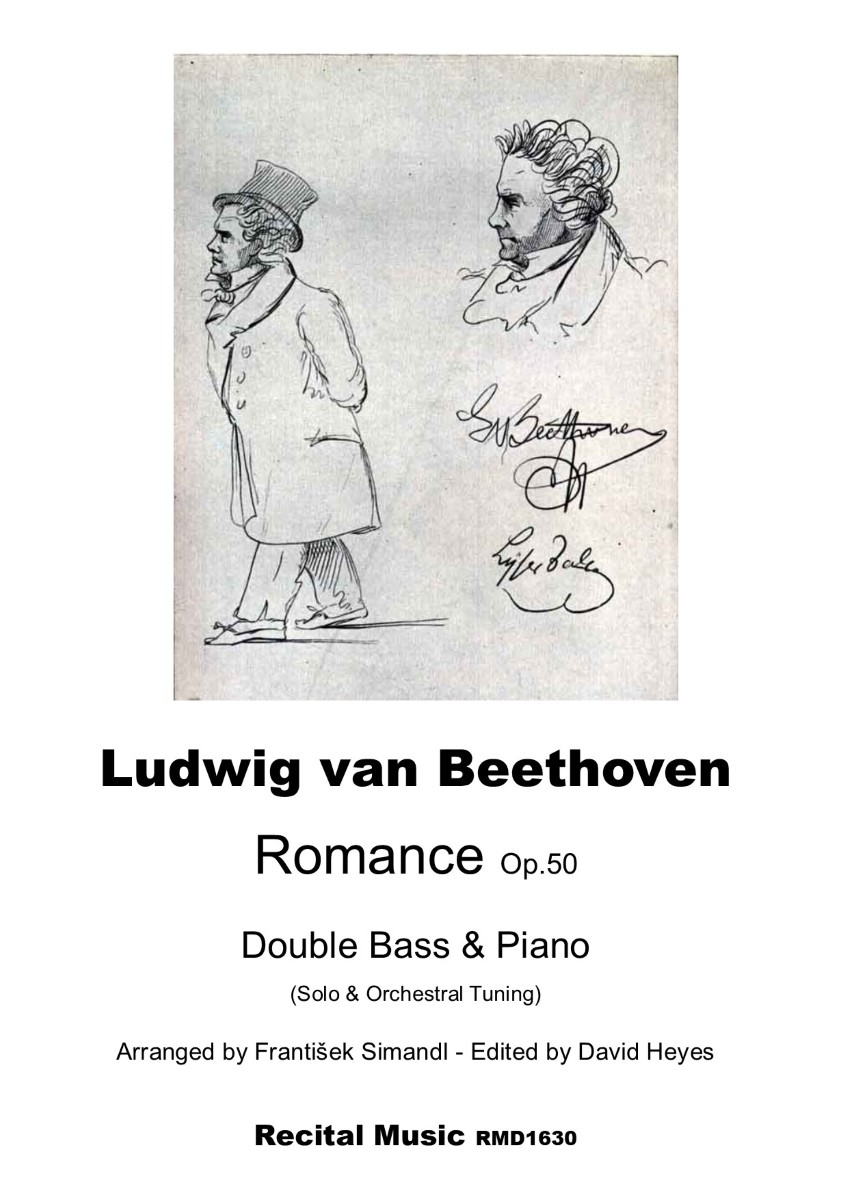
Originally for violin, František Simandl's tasteful transcription of Beethoven's Romance Op.50 for double bass and piano is now available in a new edition and with…
Originally for violin, František Simandl’s tasteful transcription of Beethoven’s Romance Op.50 for double bass and piano is now available in a new edition and with accompaniments for both solo and orchestral tunings.
First published by C.F. Schmidt (Germany) in their ground breaking series of original works and transcriptions for double bass, there are musical and technical challenges aplenty for the intermediate bassist and much to enjoy for performers and audiences alike.
Composed in 1798, shortly after Beethoven’s arrival in Vienna, Romance was not published until 1805 and there is speculation that it could have been intended as the slow movement of a violin concerto which was never completed.
Kevin Bazzana describes the work as “…a tender adagio cantabile movement that could have been titled “Song Without Words,” so beautifully and directly does it showcase the lyricism of the violin. Its form is a conventional five-part rondo (ABACA) with a short, lovely coda; however, it does offer glimpses of the impending heroic style of Beethoven’s middle-period symphonic works.”